Lavanya Acharya
Serious MenLavanya Acharya is Arvind Acharya’s wife of forty-two years and the person who most persistently anchors him to ordinary life. Their marriage is expressed less through declarations than through habitual acts of care: coffee carried to a balcony, a towel offered to a wet husband, hospital appointments remembered when he forgets nearly everything else. That intimacy does not spare her the pain of his affair or the disorientation of his later transformation. She is neither merely the injured wife nor simply his caretaker; she has her own pride, social standing, loneliness, and limits, and her eventual return is an active choice to re-enter a marriage changed by scandal and crisis.
Identity and Background
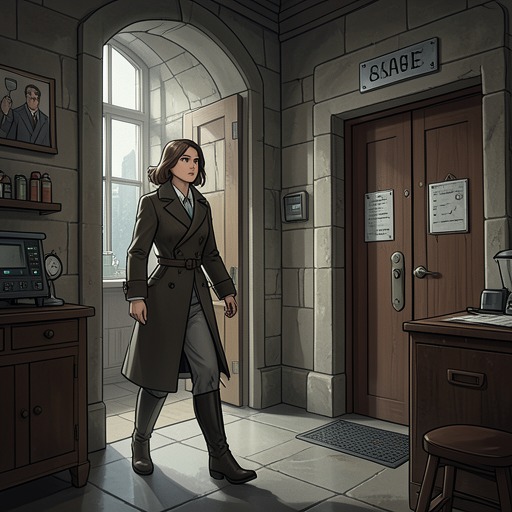
Lavanya is a tall Brahmin woman from Sivagangai, where her height became a family and marriage-market concern. When she was twelve, her mother made her walk for an hour each day inside their large, quiet house with a wooden chest balanced on her head, following a physician’s advice intended to control her growth. By eighteen she had grown to five foot nine, a height the local elite regarded as a disadvantage because tall Brahmin men were scarce. These details give her later physical presence a history: the unusual height that distinguishes her in the Institute’s Professors’ Quarters was once treated as a problem to be managed.
In the present, she is an older woman whose dyed hair has thinned and whose face and neck bear the visible marks of age. The novel sets those changes against the vivid image of the younger woman she once was: hair rich and flowing, tied up before a fight, and a movement still described as smooth and delicate. Arvind, too, changes with age, but his inward attention often turns away from her even when she is beside him. Their shared history is therefore present both in the body he has grown accustomed to and in the moments when he suddenly sees how much time has passed.
Marriage in Daily Gestures
The marriage’s ordinary rhythm emerges on the balcony of their flat, nine floors above the ground and facing the Arabian Sea. Arvind is absorbed in an abstract problem about whether time moves continuously or in minute jumps when Lavanya brings him a steel tumbler of Madras filter coffee. She waters a dying creeper with her free hand, nudges him to take the cup, and later asks him to retrieve a duster from a wire. He complains to himself about having no peace at home, but the scene makes clear how completely their life is built from such small exchanges: her requests, his reluctant compliance, and the attention neither has to explain.
Her care can be practical and unsentimental. She reminds him to exercise, asks him to bring down a suspended shrub, and keeps track of the hospital visit he must drive her to because the driver is unavailable. Lavanya’s eyesight is failing and she has a heart stent; Arvind recognizes that taking her to the hospital feels lonely and funereal, yet he remembers the appointment without being prompted. She waits beneath a neem tree beside the old sky-blue Fiat, confident he will arrive. He does, and they drive in silence. The quiet is not evidence of indifference: the reliability of his arrival is part of the language they share.
Their daughter, Shruti Acharya, is married and far away, but her presence remains in the home. A small wooden clock with Thai digits sounds her 7:45 morning alarm, set years earlier in an effort to wake early and lose weight. It never wakes her, yet Arvind finds its daily failure poignant. For Lavanya and Arvind, the alarm is one of the household’s recurring remnants of a daughter who no longer lives with them. Lavanya’s own loneliness surfaces when she watches a little girl arrange fallen jasmine flowers on a tennis court and thinks of Shruti. She feels deserted, then takes comfort in expecting her husband to come down the driveway.
Family, Age, and Loss
Lavanya’s care for Arvind coexists with irritation, humor, and a sharply observant view of aging. Their mornings include the alarm she cannot turn off and the household tasks she assigns him. At other times, familiarity makes his aging newly visible to him: her hair beneath the dye, loose skin at her neck, and the oils she rubs on herself. He associates their smell with his grandfather and death, a private association that reveals his fear of age rather than any withdrawal of her care. The marriage holds both the affection of long use and the discomfort of seeing a familiar body change.
News of death repeatedly draws Arvind’s attention, while Lavanya meets it as an immediate human loss. When she tells him that her friend Anju has died, she is tearful and shaken. She has already checked for a flight to Madras and says she must leave within two hours. Arvind asks whether she wants him to go with her; she answers that she knows he does not want to come. The exchange compresses a long marriage into a painful recognition: she knows his reluctance before he has to voice it, but still has to manage the journey and her grief.
The Affair and Its Disclosure
Arvind’s relationship with Oparna Goshmaulik turns Lavanya’s domestic life into the setting for a belated confession. After returning home late, he finds her asleep. Even after he tells her that he has been out, she reaches for a towel and wipes his wet head and face, complaining about the disordered house and threatening to give the keys to the maids. Her instinct is still to look after him. Only then does he tell her Oparna’s name and that she works with him. Lavanya understands that this is not an ordinary admission and sits down on the edge of the bed.
The disclosure does not produce a simple, immediate break. Lavanya remains present through the aftermath, but Arvind’s disgrace reaches beyond their flat: his suspension diminishes her authority among the Institute wives, and she recognizes that his public fall has advertised her own defeat at the hands of a younger woman. She tries to console him when he becomes emotionally vacant, yet does not know how to reach a man who seems withdrawn from memory and feeling. Her limited effort is not indifference. It is shaped by humiliation, exhaustion, and the knowledge that his scandal has altered her position as well as his.
Separation, Crisis, and Return
After a period in which Arvind recovers from his blankness and tells Lavanya that he has thought of her every day and that his life was good because of her, the couple briefly finds humor again. He recounts a joke he had made at a Cosmic Ancestry seminar, claiming that all life on Earth came from outer space, including his wife. Lavanya laughs and offers to make him coffee. The warmth of the exchange is real, but it does not mean that his crisis has passed. Soon afterward, he stands on the balcony railing, calculating the drop to the driveway and considering suicide. His thoughts turn instead to the unresolved questions of gravity, life, and time, and to the bitter fear that Lavanya might be happier as a widow. He slips but regains his balance.
Later, as Arvind’s behavior changes into an intense, inexplicable happiness, Lavanya reaches a limit. She tells him that she cannot handle what he has become: his joy in nothing and his conversations with objects make her feel unnecessary, even though she knows that he is happy. She holds his hand, explains that his conduct hurts her, gives instructions to the maids, packs a suitcase, and leaves for Chennai to be with her family. Her departure follows an attempt to name the injury rather than a sudden disappearance; affection remains, but it cannot make his altered state bearable to her.
Lavanya eventually returns. After the Institute riot, she spends two weeks supervising the resurrection of Arvind’s office. She surveys its newly restored room with the authority of a wife and asks whether the rioters broke everything except the framed poster of Carl Sagan. She wants to put up at least one painting, reminding Arvind that he begged her to come back; he insists that he likes the walls blank. Their disagreement is small, but it marks a changed settlement: she has resumed a place in his life and the work of making a home around him, without erasing her own preferences or his stubbornness.
Narrative Significance
Lavanya’s story makes the consequences of Arvind’s affair and institutional disgrace legible within domestic life. His public fall changes her standing among the Institute’s wives; his affair injures her marriage; his later transformation makes continued cohabitation painful. Yet the novel does not reduce her to the damage he causes. She watches, remembers, jokes, travels to mourn a friend, leaves when she can no longer bear his behavior, and returns to help restore the space in which he works.
Her care is most revealing when it becomes habitual rather than ceremonial: the coffee, the towel, the hospital drive, and the effort to make the damaged office livable again. These actions do not resolve betrayal or make the marriage uncomplicated. They show instead how attachment can persist alongside anger and distance, and how a return can be both a renewed bond and a negotiation over the terms of living together.